Trend Research for Surface Pattern Designers (Permission to Go Shopping)
Oct 27, 2026By Mandy Corcoran — surface pattern designer and former tech instructor. I build the tools I teach, including PatternPAL Pro.
Quick answer: To research surface pattern design trends, shop the stores where you want your work to land, photograph front displays and clearance shelves, then condense what you see into a one-page trend brief with three specific directions. Tie each direction to patterns you already have, and let only one pattern per collection chase the trend.
Key takeaways
- A mood board helps you brainstorm, but a trend brief tells you what to draw next.
- Retail clearance shelves show which colors and motifs are on their way out.
- A trend becomes real when the same motif shows up across several product types in one store.
- Build each collection around one trend-forward lead print and keep the coordinates evergreen.
- AI can sort your research notes into themes, but the design decisions and the art stay yours.
Not long ago, Claude dropped a massive update and I had about 36 hours to rebuild most of my Creative Systems Lab session before class went live. I moved my whole life around, showed up ready, and celebrated with a lemon drop martini. (Earned it.)
The good news? Trend research is almost never that dramatic. Nobody discontinues the color green overnight. Design trends move slowly and leave clues along the way. This post is for surface pattern designers who want to spot those clues early and turn them into an actual plan for what to draw next.
Why isn’t my trend research turning into patterns?
Usually it’s because the research doesn't connect back to your portfolio.
Have you ever spent a whole Sunday building a gorgeous mood board? Ninety pins. Felt very productive.
And then you never opened it again.
Same.
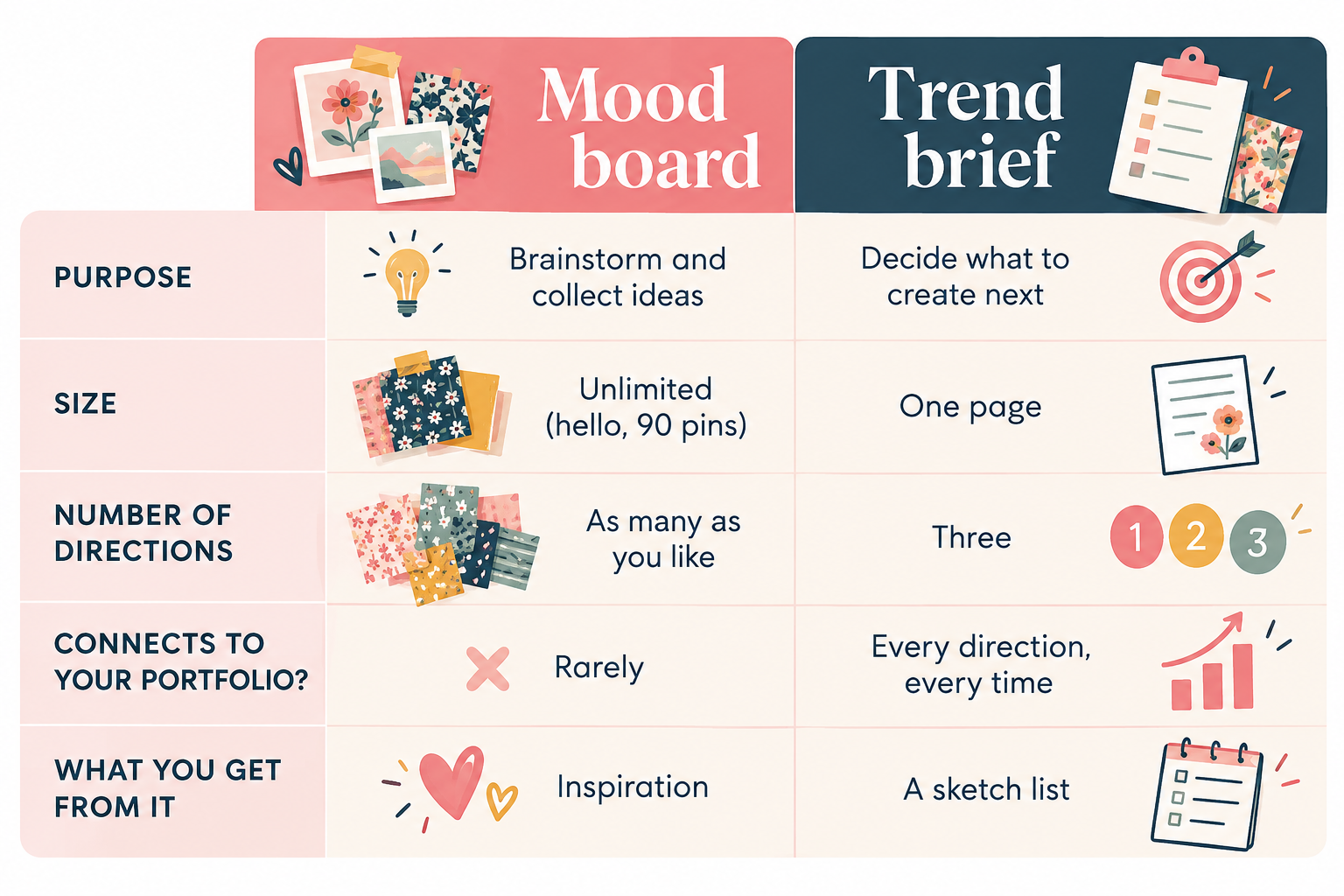
Mood boards work for brainstorming. They’re like doodling: they get ideas moving. But a mood board won’t tell you what to sketch on Monday morning. For that, I use a trend brief.
What is a trend brief, and how is it different from a mood board?
A trend brief is a one-page document that turns your research into a decision. It names three specific trend directions, describes each one in plain words, and ties each to a pattern you already have or a motif you want to draw next. What you end up with is a sketch list you can start on Monday morning.
A mood board is for brainstorming. It’s where you collect ideas, and there’s no limit to how big it can get (hello, 90 pins). You can follow as many directions as you want, and it rarely ties back to the patterns you already have. What you get out of it is inspiration, and that’s useful, but it stops there.
That last part is the whole point.
If your research doesn’t tie back to your own work, you’re just collecting pictures.
How do I make a one-page trend brief?
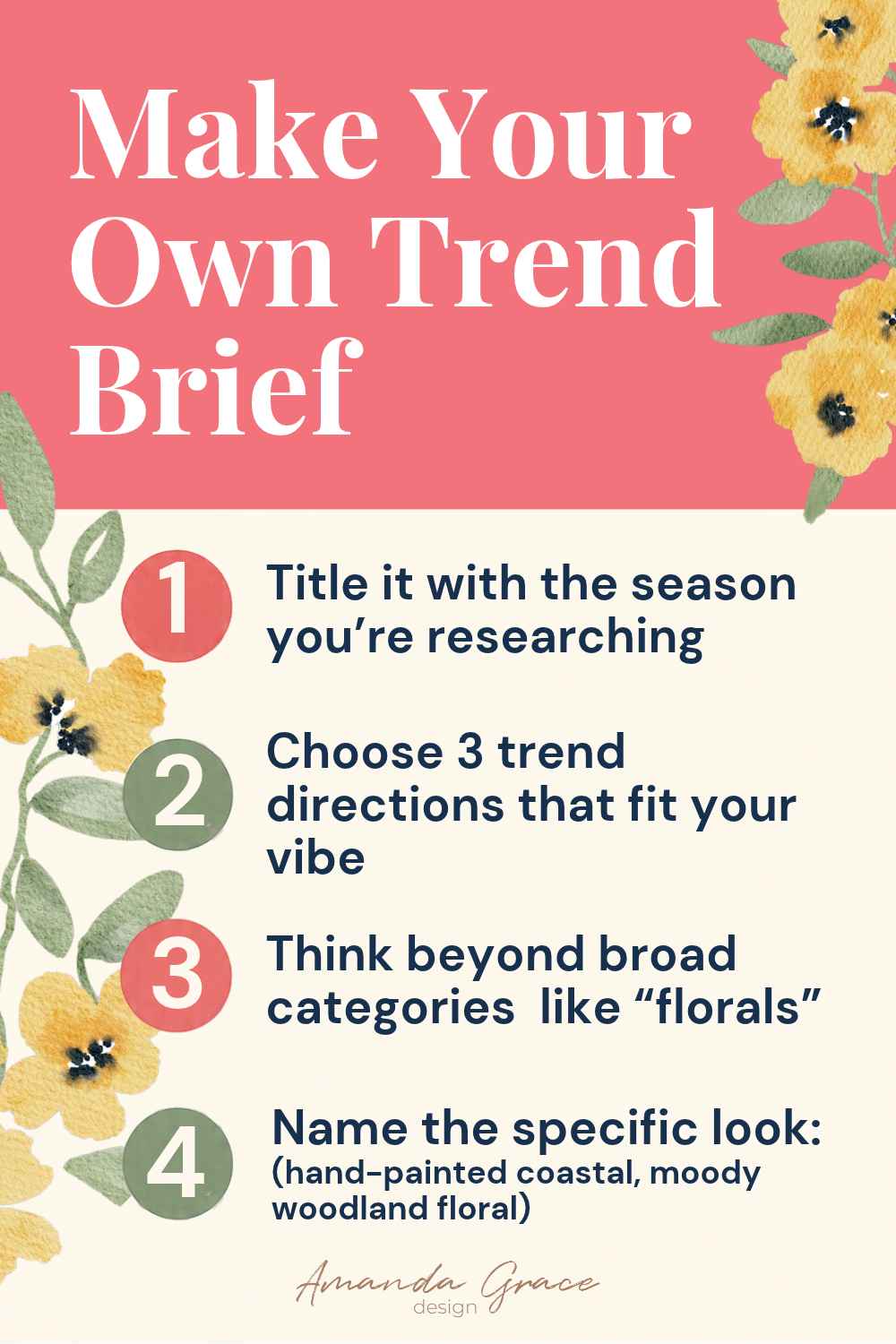
Title it with the season buyers are shopping for, pick three specific trend directions, and fill in the same four details for each one. A Google Doc, a Notion page, or a sheet of paper taped above your desk works fine.
- Title it with the season you’re researching. Something like Spring/Summer 2027. Retail buyers work well ahead of the calendar, so aim at the season they’re buying for, not the one you’re living in.
- Pick three trend directions you could realistically turn into patterns. Three. Not twelve. And keep them specific. “Florals” isn’t a trend direction. That's too broad. Name the look instead:
- Moody woodland florals
- Hand-painted coastal
- Playful retro kitchen
- Fill in four things for each direction:
- Five words that describe the look
- No more than five reference images
- Which of your current patterns are a similar fit
- One or two new motifs you want to explore
- Keep it where you’ll see it. A brief buried in a folder works about as well as a mood board buried in Pinterest. Print it out. Keep it near your desk, or make it the first thing you open when you sit down to draw.
Here’s what one section might look like:
Moody woodland florals
Words: deep, layered, mossy, vintage, cozy
References: 4 store photos, 2 product pages
Already have: my dark botanical repeat could work with a deeper background
Explore next: ferns and mushrooms with small wildflowers
See how quickly that gets specific? You can look at that and know exactly what to sketch.
Where can I find design trends without buying a trend report?
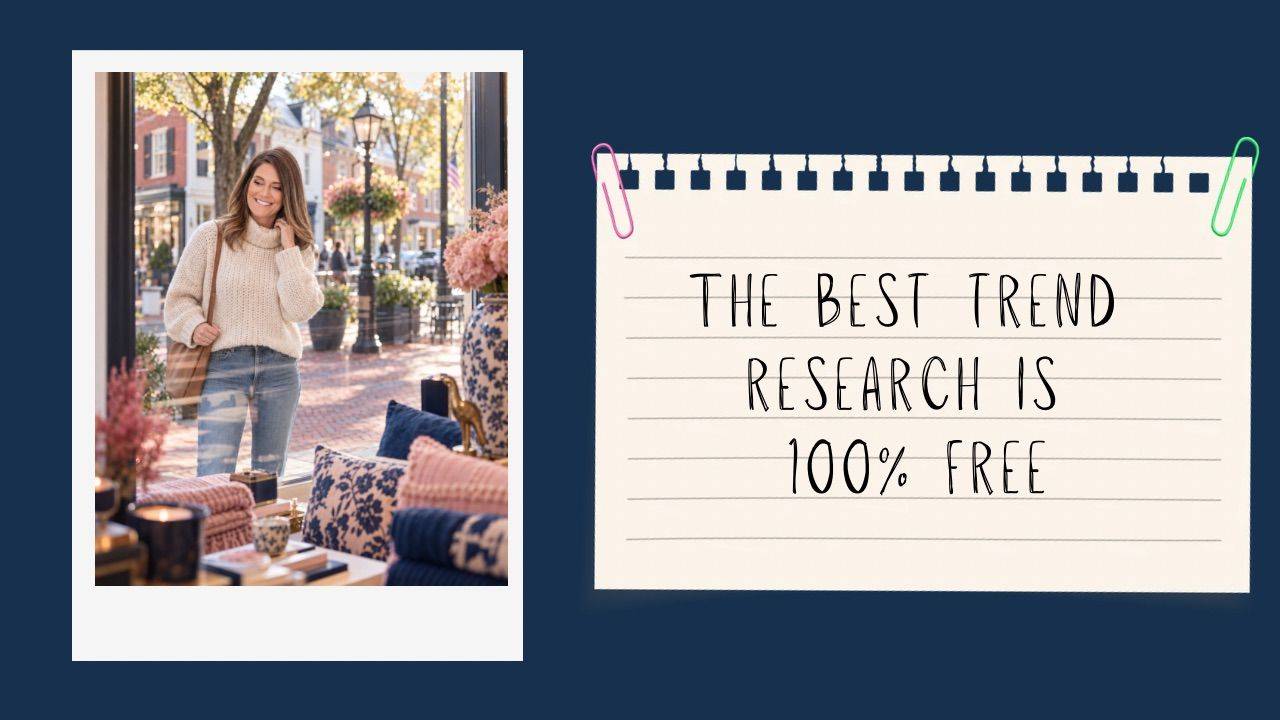
Walk through the stores where you’d love to see your work, and pay attention like a buyer. Trend reports can help, but a generic report can’t tell you which trends fit your style. You know your work better than any report does.
That’s how I ended up in a HomeGoods aisle one Saturday, phone out, photographing a clearance shelf. An employee came over and asked if I needed help finding anything.
“Nope. Just doing research.”
Totally normal behavior.
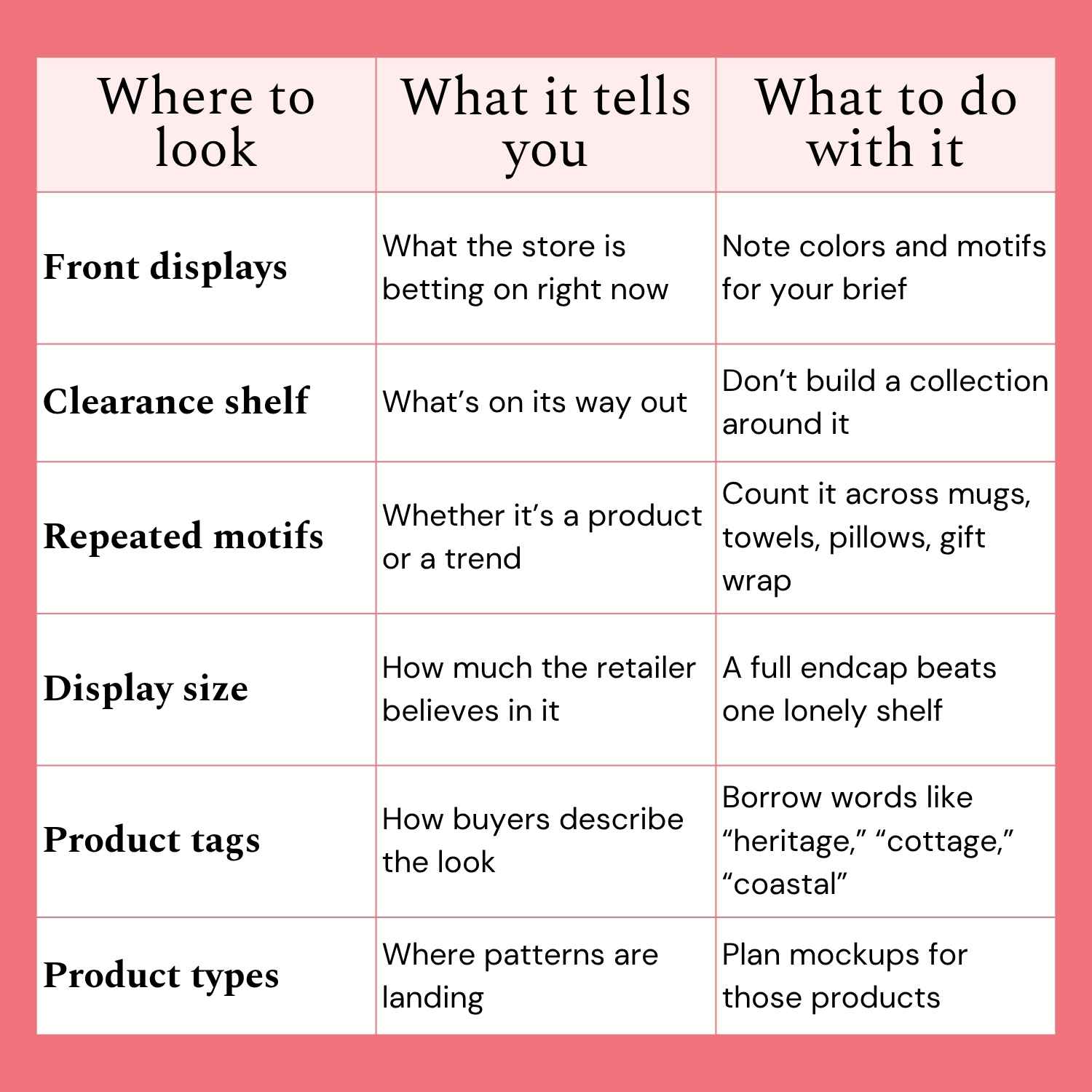
For me, the stores are HomeGoods and TJ Maxx. For you, it might be Target, Anthropologie, a fabric store, or a local boutique. Here’s what I look for:
For me, the stores are HomeGoods and TJ Maxx. For you, it might be Target, Anthropologie, a fabric store, or a local boutique. Wherever you go, here’s what I want you to pay attention to.
Start with the front displays. Whatever a store puts up front is what it’s betting on right now, so jot down the colors and motifs you see there for your brief.
Then go find the clearance shelf, the spot most people skip. Clearance shows you what’s on its way out. If a color or motif is all over the markdown racks, I’m not building a collection around it.
Watch for repetition, because that’s how you tell a product from a trend. One mushroom mug is a product. Mushrooms on mugs, towels, pillows, and gift wrap is a trend. Count how many times a motif shows up across different product types before you get excited about it.
Display size matters too. A full endcap tells you the retailer really believes in a look. One lonely shelf doesn’t say much.
Read the tags. The words retailers use to describe products show you how buyers are thinking. When you keep seeing “heritage,” “cottage,” or “coastal,” borrow those words for your brief and your pattern descriptions.
Finally, notice which products keep showing up with patterns on them. That tells you where your work could land, and it’s a good guide for which mockups to make next.
Take photos of everything, including clearance. Comparing what’s coming in with what’s going out gives you one of the clearest pictures you’ll get.
Can’t get to a store this week? Browse the “new arrivals” pages for retailers you’d love to work with and notice which themes keep repeating.
How can AI help me sort my trend research?
AI can group your notes into themes and pull out repeating words, so you get to the decisions faster. It doesn’t make the decisions, and it never touches the art.
Here’s where people get stuck: you come home with 140 photos and a pile of half-scribbled notes. Then what?
What I’d do is drop your notes and short photo descriptions into a Claude Project and ask it to:
- Group everything into three to five themes
- List the words that show up again and again
- Rank which themes appeared most often, and in how many product types
AI sorts the mess. You make the calls. And you definitely make the art. (AI never touches my art. It runs the admin so I can stay in the studio.)
If organizing research like this makes your brain hurt, it’s exactly the kind of business-side work we tackle inside Creative Systems Lab. We build systems for the boring parts so you get more time for the fun parts.
Your next step: Block off one evening this week and build your first trend brief. One page.
How many patterns in a collection should follow a trend?
One. That's not a rule written in stone. It's just a good rule of thumb. Let one lead print carry the trend and keep the rest of the collection evergreen.
None of us has a crystal ball. We make our best guess about what will sell, and sometimes we guess wrong.
Mandy’s take: the 12-pattern lesson
I once got so excited about a trend that I built an entire 12-pattern collection around it. Six months later, that trend was declared dead.
I was heartbroken. That was a lot of hours.
So now I mostly stick with evergreen motifs like florals, botanicals, fruit, and birds, which have been selling for a very long time. But I still like to play with something trendy. I just don’t bet the whole collection on it.
Lead with the trend, back it up with staples
Pick one pattern to lean into the trend: the trendy palette, motif, or style. The rest stays steady:
- A small geometric
- A ditsy (a tiny, scattered all-over print)
- A texture or blender
- A simple motif that still works after the trend moves on
Let’s say your brief points to moody woodland florals. Your lead print is a dark, layered floral with ferns and mushrooms. Your coordinates are a small leaf ditsy, a tonal texture, and a simple stripe pulled from the same palette.
If woodland florals fade next year, three of those four patterns still have a long life ahead of them.
Why this makes your collection easier to pitch
You can tell a buyer the lead print was designed with Spring 2027 in mind, while the supporting patterns will keep working for seasons to come. Buyers like knowing you understand their business: you’re paying attention to what’s happening now without handing them a collection that expires next Tuesday.
Your next step: Open the collection you’re working on and name the lead pattern. Can’t tell which one it is? Then the collection needs a little more structure. Grab my free Pattern Collection Playbook. It walks you through giving every collection a clear lead and a supporting cast.
Frequently Asked Questions
How do surface pattern designers research trends?
Start in the stores where you want your work sold. Photograph front displays, clearance shelves, and any motif that repeats across several product types. Check retailers’ new arrivals pages online too. Then condense everything into a one-page trend brief with three specific directions, and connect each direction to patterns you already have or motifs you plan to draw next.
What is a trend brief in surface pattern design?
A trend brief is a one-page planning document that turns trend research into decisions. It names three specific trend directions, such as moody woodland florals, and lists five describing words, up to six reference images, current patterns that fit, and new motifs to explore for each one. Unlike a mood board, it tells you exactly what to design next.
How many patterns in a collection should be trendy?
One. Let a single lead print carry the trendy palette, motif, or style, and build the coordinates from evergreen staples like a small geometric, a ditsy, a texture, or a simple motif. If the trend fades, most of the collection keeps selling, and buyers see that you understand both current trends and long-term value.
Do I need to buy a trend report to find design trends?
No. Trend reports can be useful, but they can’t tell you which trends fit your style. Walking through stores like HomeGoods, TJ Maxx, Target, or a local boutique, and browsing new arrivals pages online, shows you what retailers are betting on right now and what they’re clearing out.
Can AI design trendy patterns for me?
Not in my business. I use AI only for the business side, like sorting trend research notes into themes, spotting repeated words, and organizing my planning. The design decisions and every pattern stay mine. AI never touches my art. It runs the admin so I can stay in the studio.
Ready for a system that does the sorting for you?
Join Creative Systems Lab to build simple systems for trend research, planning, and the rest of the business side of your art.
About the author
Mandy Corcoran is a surface pattern designer and the founder of Amanda Grace Design and Creative Systems Lab, where she teaches artists to build the business side of a licensing and print-on-demand career. She has more than 10 years of experience, and her work has landed with retailers including HomeGoods, TJ Maxx, and Nordstrom Rack.
Related posts