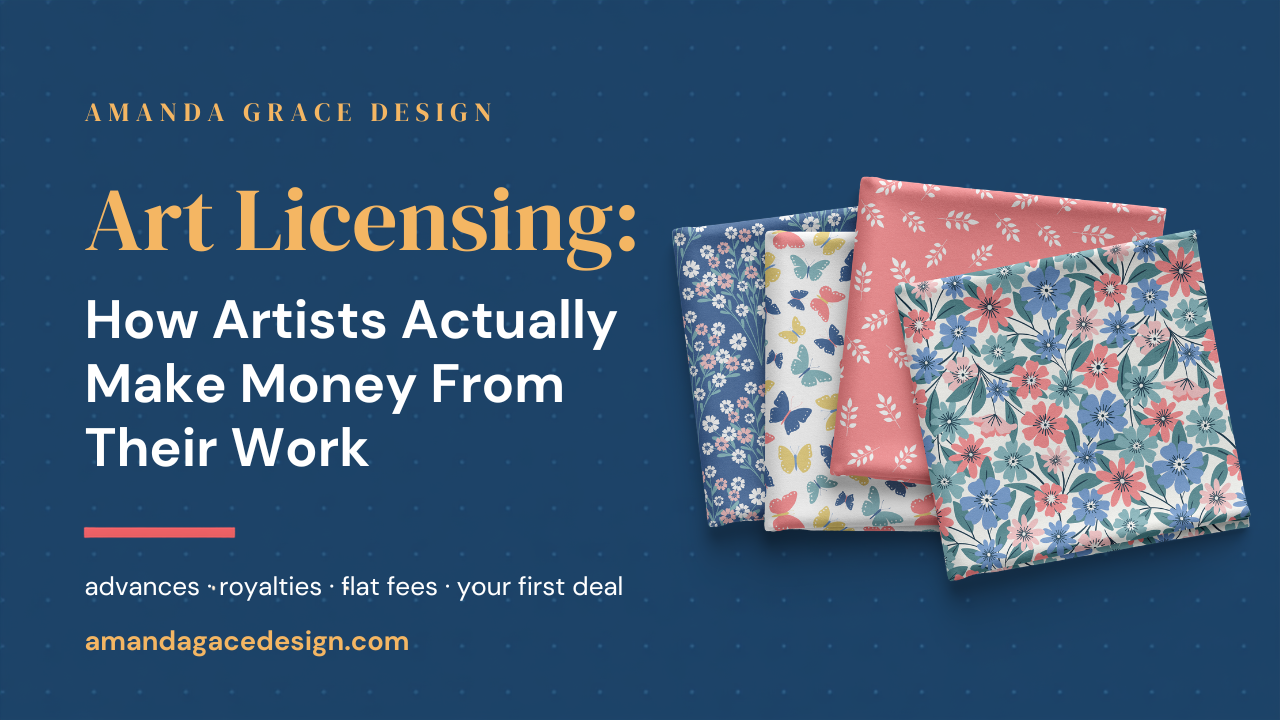
Art Licensing: How Artists Actually Make Money From Their Work
Jul 03, 2026Somebody sees your work on Instagram, sends you a DM that says "we'd love to license this," and your first thought is: I have no idea what that actually pays.
You're not alone. Art licensing is the single most-searched money question in this industry, and it's also the one nobody answers with real numbers. You get either "it depends" (true, useless) or a hype reel about passive income (not true, also useless).
So let's do this properly. I've spent 10 years as a working surface pattern designer with art licensed to Apple, Nordstrom, HomeGoods, and TJ Maxx — and I've coached 100+ creative business owners through their first (and tenth) licensing deals. Here's how the money actually works.
What is art licensing?
Art licensing means a company pays you for permission to use your artwork on their products — fabric, bedding, stationery, wallpaper, apparel, packaging, you name it. You still own the art. They're renting it, for a specific use, for a specific time.
That last sentence matters more than anything else in this post. You are not selling your art. You're licensing the use of it. Same pattern, licensed to a fabric company for quilting cotton and to a stationery brand for gift wrap, earns twice. That's the whole engine.
How the money works: flat fees, royalties, and advances
Licensing deals pay in three basic shapes. Most contracts are one of these or a combination.
1. Flat fee
The company pays once for a defined use. Common with fabric collections, digital marketplaces, and smaller brands. The check is predictable, there's no waiting on sales reports, and when the term ends, you can license the work again. The trade: if the product takes off, you don't share in the upside.
2. Royalties
You earn a percentage of sales — in art licensing, royalty rates commonly land in the low-to-mid single digits, with the exact number depending on the product category, the size of the brand, and how the contract defines "net sales." (That definition is where the real negotiation lives. Read it twice.) Royalties are slower money, but a design that keeps selling keeps paying.
3. Advances
An advance is royalty money paid up front, then earned out as the product sells. Not every deal includes one, and smaller brands often skip them entirely. When one shows up, think of it as the company sharing the risk with you — a good sign.
Here's what I want you to take from this: none of these shapes is "the good one." A flat fee from a company that ships tomorrow can beat a royalty deal that sits in product development for 18 months. The right answer depends on your business — which is exactly why "what should I charge?" is a strategy question, not a Google question.
What a first licensing deal really looks like
Real talk: your first deal will probably be smaller than you hoped and slower than you expected. That's normal, and it's not the point.
The point of a first deal is that it changes your category. You're no longer a designer hoping to license — you're a licensed designer with a track record, a contract you've been through once, and a brand relationship you can grow. The second sale is always easier — one deal handled well becomes a repeat client, and repeat clients are where licensing income stops being a lottery ticket and starts being a revenue stream.
Let's say a small home-goods brand licenses one of your patterns for tea towels at a modest flat fee. Underwhelming? Maybe. But now you have: a signed contract you understand, product in the world with your art on it, photos for your portfolio, and a buyer who already said yes once. That's not a small deal. That's infrastructure.
Art licensing companies and agencies: where the deals actually come from
When people search "art licensing companies," they usually mean one of two different things — and the difference matters.
Companies that license art are the buyers: manufacturers and brands in fabric, stationery, home decor, gift, apparel, and packaging. You can pitch these directly. Art directors at these companies are actively looking for fresh work — they're findable, and they do respond when you pitch the way they buy.
Art licensing agencies represent artists and pitch on their behalf, typically for a significant share of your licensing revenue. In return you get their relationships and their sales work. Whether that trade makes sense depends on your catalog size, your appetite for outreach, and your stage of business — I wrote a whole post to help you decide: Do You Need an Art Licensing Agent?
My honest take after a decade in this: you don't need an agent to get licensed. You need a focused portfolio, a target list, and a follow-up system. An agent can multiply that machine — but they can't replace it.
What brands actually want to see (it's not more art)
Here's where people get stuck. They think the path to licensing is making more patterns. It's not. It's making organized patterns.
Brands license collections, not one-offs — a hero print with coordinates that work together on a product line. And they license art they can picture on their product, which is why pitching pillows beats pitching patterns. After reviewing 100+ portfolios in coaching audits, I can tell you the difference between designers who get responses and designers who get crickets is almost never talent. It's presentation and fit.
How to get started with art licensing (the short version)
What I would do, in order:
- Build one licensing-ready collection. A hero, coordinates, and blenders that clearly belong together. One strong collection beats forty scattered patterns.
- Mock it up on products. Art directors buy what they can picture. Show the pillow, the fabric bolt, the gift wrap — not just the flat repeat.
- Make a target list of 10 companies whose products your work already fits. Not 100. Ten you can actually research.
- Pitch, then follow up. Most deals die from silence, not rejection. A simple tracker — who you pitched, when, what happened — outperforms talent alone, every time.
The three leaks that keep artists underpaid
After 100+ coaching audits, the same three leaks show up in almost every licensing business that's stuck:
Leak 1: No revenue plan. Pitching everyone, everywhere, with no idea which channel — licensing, POD, wholesale, digital products — actually fits the work and the life. Scattered effort reads as scattered work.
Leak 2: One-deal thinking. Treating each contract as a finish line instead of the start of a client relationship. The money in licensing is in deal two, three, and four with the same brand.
Leak 3: No follow-up system. The pitch went out, the silence came back, and the trail went cold. The simple fact is a spreadsheet and a monthly follow-up rhythm will out-earn another new collection almost every time.
Notice that none of those leaks is about the art. That's the pattern (pun fully intended): licensing problems are almost always business problems wearing an art costume.
Art licensing FAQ
How much does art licensing pay?
It ranges from small flat fees on single designs to meaningful recurring royalty income across a licensed catalog. The honest answer: one deal rarely changes your life; a system that produces repeat deals absolutely can.
Do I need an agent to license my art?
No. Many working designers license directly to brands. An agent trades a share of your revenue for their relationships and pitching. Worth considering once you have a deep catalog — rarely necessary to start. Full breakdown here.
Do I keep the copyright when I license my art?
Yes — that's the defining feature of licensing. You grant specific usage rights for a specific term. If a contract asks to buy your copyright outright, that's not licensing, and it should be priced very differently.
How do I find companies that license art?
Start with brands whose products already look like your work belongs on them. Study fabric companies, stationery brands, and home-goods manufacturers in your style lane, then find the art directors behind them.
You don't need more ideas. You need a plan.
If you've read this far, you're probably not short on talent or effort. You're short on a revenue plan — which of these channels fits your work, what to charge, who to pitch first, and how to keep the pipeline moving without it eating your studio time.
That's exactly what the Art Biz Audit is: 75 focused minutes on your actual business, a personalized action roadmap in Notion within 24 hours, the full recording, and 7 days of follow-up access. I take 3 calls per Tuesday, and booking is open.