
Why Isn't My Art Selling? How to Diagnose a Slow Sales Season (5 Clues to Check)
Oct 23, 2026By Mandy Corcoran — surface pattern designer and former tech instructor. I build the tools I teach, including PatternPAL Pro.
Quick answer: If people are viewing your art but not buying, your visibility is probably fine. The breakdown is happening somewhere between interest and checkout. Compare this year's shop numbers to the same season last year, check pricing and checkout, then look outside your shop at your niche, platform changes, trends, and the market before changing anything.
Key takeaways
- If views are steady but sales have dropped, your visibility probably isn't the problem.
- Compare your current shop numbers to the same season last year before you change anything.
- A sales slowdown can come from your listings, your niche, your platform, shifting trends, or the broader economy, and each one needs a different fix.
- AI tools like Claude can help you sort facts from theories, but you make the final call.
- A slow season is information about your business, not a verdict on your art.
A few weeks ago, an artist posted something I haven't been able to shake: "I don't have a problem with the views, I have a problem with people actually purchasing my products."
If your shop stats look busy but your sales notifications have gone quiet, this one's for you. And no, I'm not sending you off to redo your tags. (You already did that. Probably twice.) This is about what's happening around your shop, so you can find the real cause before you touch a thing.
Why are people viewing my art but not buying it?
Because what gets someone to look isn't always what gets them to buy. Views tell you you're being found. Sales depend on a lot of things and some of those things aren't fully under your control.
Customer habits shift. Trends rotate in and out. Household budgets tighten. Platforms tweak algorithms, add security steps, and change how shoppers discover products.
In a normal year, that's a slow trickle. A couple of trends fade, a couple show up, and a platform update lands here and there. Lately? It feels like at least one platform changes something almost every day.
Plus, building a business is a different job than keeping one going. The U.S. Small Business Administration reports that only about half of new businesses with employees make it to the five-year mark. That's not an artist-specific number, but it's a useful reality check. Staying in business takes ongoing detective work, not a one-time setup.
So grab your magnifying glass. 🔍
What are my shop's numbers actually telling me?
Your analytics show you where buyers are dropping off. Before you change a listing, pull your store data and compare a recent stretch to an earlier one, ideally the same season last year. (Comparing November to July is like comparing apples to pumpkin spice.)
Follow the three-stage trail
- Visibility: Are people still finding your designs?
- Interest: Are they clicking, saving, favoriting, or adding to cart?
- Sales: Are interested shoppers actually checking out?
If views are steady but purchases dropped, your visibility is probably fine. People are finding you. They're just not clicking "buy." That's a very different problem than nobody showing up.
Check the buying experience
Next, look at what changed for the shopper:
- Did your prices go up, or did the platform's base prices shift?
- Did shipping costs change?
- Were product options added, removed, or renamed?
- Is anything new happening at checkout, like fees, minimums, or extra steps?
Compare across listings
- Are all your sales down? That points to something site-wide.
- Did only your bestseller tank? That could be a problem with that one listing, or an early sign of a trend shift.
Here's where people get stuck. They spot one suspicious number and start "fixing" everything. Don't haul in a suspect until the evidence is in. Changing five things at once is tampering with the crime scene, and now you'll never know what actually worked.
Where else should I look if my shop seems fine?
When your analytics explain what happened but not why, the answer is usually outside your shop. Time to leave the office and question a few witnesses. 🕵️♀️
Your niche
Is demand cooling for your subject or product category? Run your main keywords through Google Trends and see how similar products are holding up. If the whole neighborhood went quiet, it isn't just your house.
This is also a good moment to get crystal clear on who your buyer actually is. My free Master the ABCs of Your Art Biz resource walks you through your ideal customer, niche, and value proposition with AI prompts, so you can tell whether your niche cooled off or just got a little fuzzy.
Your platform
Are other sellers reporting the same drop? Read official platform announcements and skim seller communities. When a dozen shops report the same problems on the same night, you're looking at an "inside job," not a problem with your patterns.
The trends
Have buyers drifted toward different colors, motifs, or product uses? Tastes change. Sometimes the trail just goes cold on last year's palette.
The market
Are higher prices, pricier shipping, or tighter budgets making shoppers hesitate? When people are watching every dollar, "I love this" doesn't always turn into "add to cart."
You're looking for a pattern of clues, not one dramatic piece of evidence. (Pattern designers, we were made for this.)
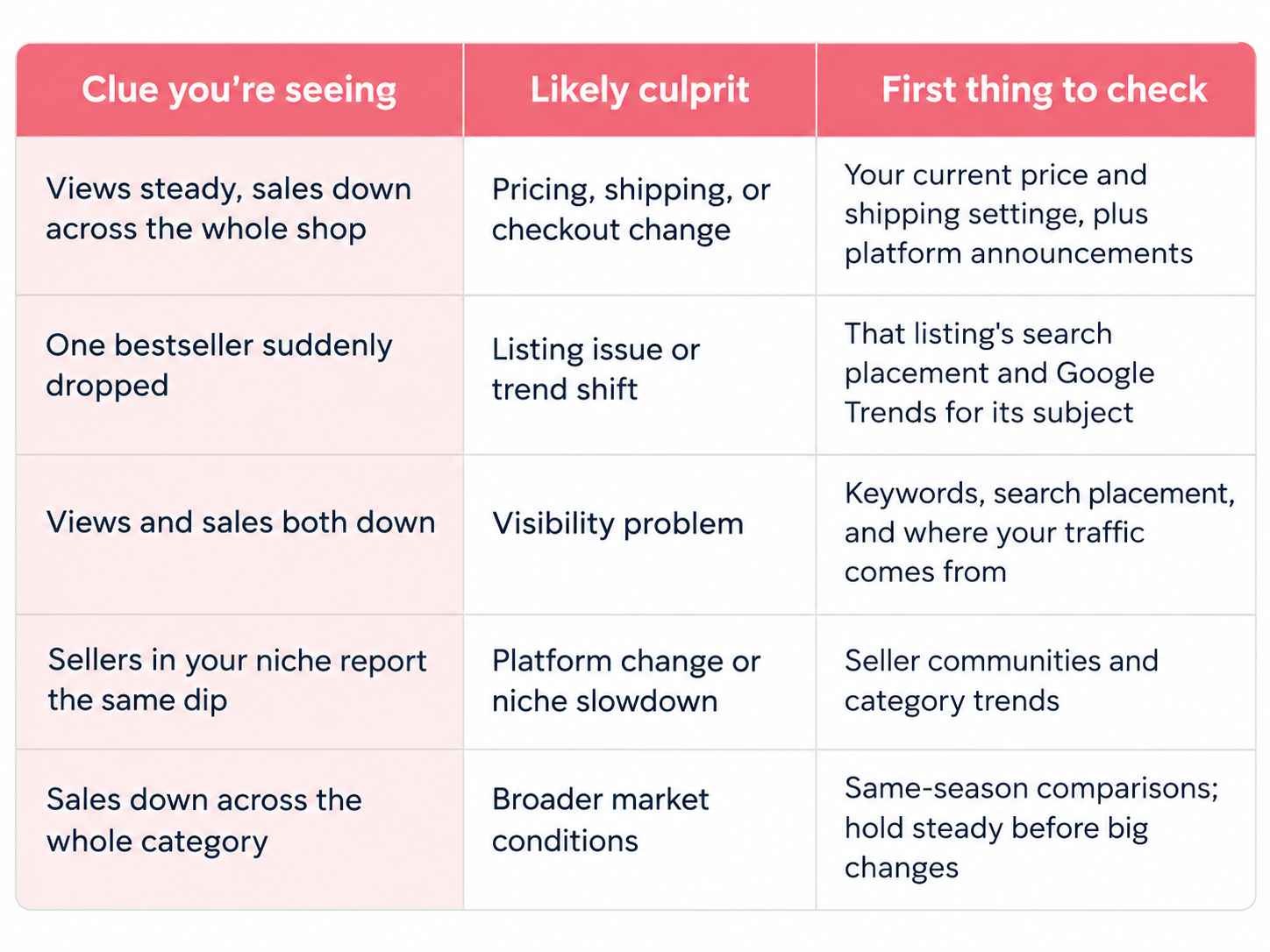
If you landed in that third row, discoverability is your first stop. Something that might help you with discoverability, Instagram posts are now indexed by Google, and my Get Discovered on Instagram course shows surface pattern designers how to turn their grid into a searchable portfolio.
Each culprit calls for a different response. Pin the blame on the wrong one, and you'll spend weeks fixing a problem you don't have.

Can AI help me figure out why my art isn't selling?
Yes. AI is great at sorting messy evidence, so you don't have to connect every dot alone. It can't know your shop the way you do, though, so it handles the analysis and you make the call.
What I'd do:
- Gather your shop numbers for this period and the same period last year.
- Copy in notes from seller discussions and any relevant platform announcements.
- Add what you found about your niche in Google Trends.
- Put everything into a Claude Project (handy if you'll repeat this every season, since your files stay in one place) and use this prompt:
Act as a business research analyst. I'm a surface pattern designer investigating why my shop gets [X] views but [X] fewer sales. I'll give you my store analytics and some outside market information. Help me identify whether the evidence points to a listing problem, niche slowdown, platform change, shifting trends, or broader market conditions. Separate facts from theories, tell me what evidence is missing, and recommend three things I can investigate or test before making big changes.
Let AI organize the clues. You stay the lead detective. And for the record, AI never touches my art. It handles the spreadsheets so I can stay in the studio.
Does a slow sales season mean something is wrong with my shop?
Not necessarily. A dip is information, not a judgment on your art or your business. What you do with that information matters more than the dip itself.
What I do when my Spoonflower notifications go quiet?
I know how it feels. When the sales notifications stop, it's tempting to decide every pattern you've ever made is the problem and you need to start over. I've been there. It's tough to get seen on platforms that have hundreds of thousands of designs.
Most of the time, the answer lands in one of three buckets:
- Fix something. A listing isn't showing up in search, or a collection is missing its coordinates.
- Change direction. The market shifted. Or you did. That's allowed.
- Ride it out. No panic sales, no deleting half your portfolio, no midnight rebrand. Just steady, boring consistency while the season turns.
The hard part is figuring out which bucket you're in. That's the whole point of the investigation.
Frequently Asked Questions
Why isn't my art selling even though people are viewing it?
When views hold steady but sales drop, people are finding your work but something stops them at the buying stage. Check whether prices, shipping costs, product options, or checkout steps have changed. Then look outside your shop at your niche, platform updates, color and style trends, and shopper budgets. Compare against the same season last year so you don't mistake a normal seasonal swing for a problem.
How do I know if a platform change is hurting my sales?
Read the platform's official announcements and check seller communities for reports of a similar drop around the same dates. If many shops in different niches saw sales fall at the same time, the cause is likely on the platform's end rather than in your listings. In that case, avoid overhauling your shop and keep watching your numbers while things settle.
Should I lower my prices when my art sales slow down?
Not as a first move. Panic discounts can train buyers to wait for sales and cut into your margins without fixing the real problem. First figure out what's causing the slowdown by comparing your numbers and checking outside factors. If tighter shopper budgets turn out to be the culprit, a planned promotion can make sense. A reactive one usually doesn't.
How long should I wait before making changes to my shop?
Long enough to gather evidence. Compare at least a few weeks of current data against the same period last year, and check outside factors before you act. Then change one thing at a time so you can tell what actually worked. Changing everything at once makes it impossible to know which fix helped and which one hurt.
Will AI make my patterns for me?
Not in my business. I use AI only for the business side: sorting analytics, organizing research, drafting emails, and planning. AI never touches my art. In this case, a tool like Claude can help you sort shop data and market notes into facts and theories, but the designs, and the final decisions about your shop, stay yours.
Your Next Step
Try one thing this week: pull up last year's numbers next to this year's and see which clue jumps out first. If you'd rather not play detective solo, book an Art Biz Audit and we'll look at the evidence together and map out your next steps.
About the author
Mandy Corcoran is a surface pattern designer and the founder of Amanda Grace Design and Creative Systems Lab. Her artwork is licensed by brands including Nordstrom, HomeGoods, and TJ Maxx. Before designing full-time, she spent 25 years in tech, including a decade teaching network engineering and web design, and she has spoken at multiple AI summits. Through Creative Systems Lab, she helps artists combine creativity with practical systems to build sustainable design businesses.
Related posts
- Are the Right Buyers Finding Your Patterns? Here's What You're Missing
- Surface Pattern Success: Discover Your Ideal Customer Avatar
- The Art of Picking Your Design Lane & Staying In It
Want practical surface design and art-business tips every week? Join the 3, 2, 1...Let's Design Eduletter.