
What Is Claude AI? How It Levels the Playing Field for Artists Who Run a Business
Oct 08, 2026By Mandy Corcoran — surface pattern designer and former tech instructor. I build the tools I teach, including PatternPAL Pro.
You Don't Need a Bigger Team. You Need a Back Office. A plain-English introduction to Claude for artists who run their own business
The day you put your creativity out into the world was the day everything changed for you. Maybe you didn't feel it right away, but that's when the creeping overwhelm started. I know. Because it happened to me.
I went from a happy artist who enjoyed drawing and creating patterns on my iPad to a small business owner in charge of creating content for my website, newsletter, keywords, tags, and captions. I had to learn how to pitch, follow-up, track sales, file taxes more than once a year. I had to decide if I was going to run ads, teach courses, create lead magnets, set up a Spoonflower shop.
If anything broke, it was on me to fix it. If a customer or client had a problem, it was on me to fix it.
Just one person. Me.
Doing the job of one hundred.

Well, maybe not that many. But it felt like it.
Most of us start a creative business because we love making art. Then we wake up and realize we're also the marketing department, the copywriter, the SEO person, the customer service desk, and the admin assistant.
All of them. Every day.
Meanwhile, the bigger brands you're competing with? They have a whole team for that.
That's the part I want to talk about today. Because the tool I use every single day to run the business side of Amanda Grace Design is Claude. And once you understand how it works (on a really basic level, I promise), you'll see why I think it's the closest thing to a fair fight small creative businesses have ever had.
So what is Claude, really?
Claude is an AI assistant made by a company called Anthropic. You talk to it by typing (or talking) in plain language, the same way you'd talk to a co-worker or a client, and it talks back.
You don't use code.
Under the hood, Claude is what's called a large language model. (Fancy name. Simple idea.) It learned the patterns of language by studying an enormous amount of text. So when you ask it something, it doesn't look up a canned answer. It writes a brand-new response based on everything it learned plus everything you just told it.
Anthropic describes Claude as a thinking partner, not just a chatbot. I like that. And that's how I use it. It can help you:
- Write and rewrite (emails, blog posts, captions, product descriptions)
- Research and make sense of long documents (it can read the equivalent of hundreds of pages in a few minutes.)
- Brainstorm and talk through a problem when you're stuck
- Organize the messy stuff (notes, to-do lists, content calendars)
- Learn something new at your own pace
And you can use it on the web, on your desktop, or on your phone. Same conversations, wherever you are. (Yes, including the school pickup line.)
How does Claude work when you talk to it?
People I talk to tend to fall into one of two camps. Either they tried AI once and think it's stupid and overrated or they're super suspicious of AI and think it's going to do something evil the minute they try it.
The people who think AI is stupid or overrated usually tried to use Claude (or another AI) cold. So they did something like: opened Claude and first thing, typed "write me an Instagram caption," got something super generic and boring, and decided AI is not worth their time.
But let me ask you this. Would you hand a brand-new assistant one sentence on their first day and expect them to nail your brand?
Of course not.

Claude knows nothing about your business until you tell it. It can work as an efficient assistant who has read just about everything... but there are a few things to know:
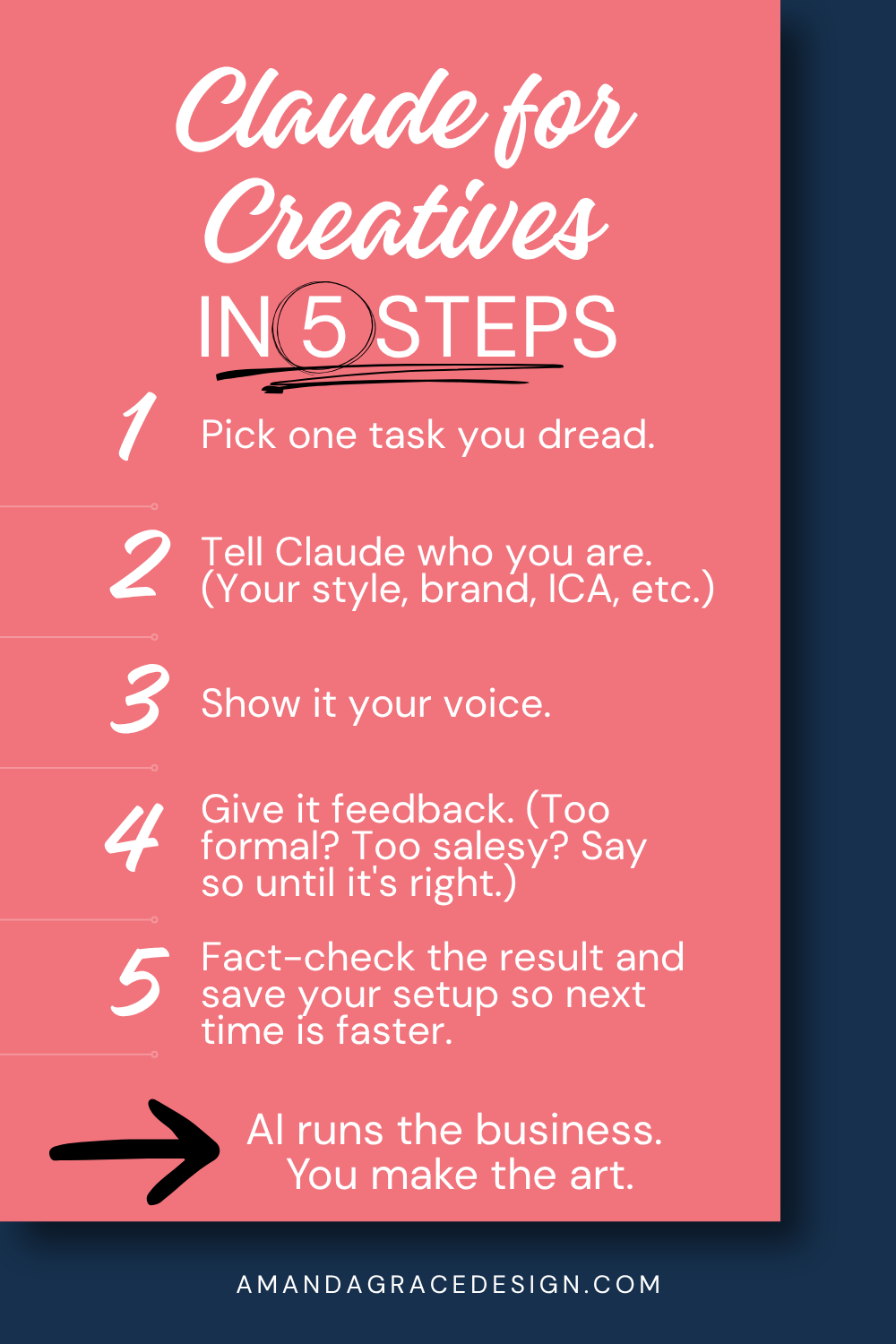
1. It works from what you give it. The more context you share (who you sell to, your style, your color preferences, how you sound when you write), the better the result. Think of it like a repeat tile. A strong motif will carry through the whole design. A single line isn't going to give you anything worthwhile.
2. You can steer it. Claude is built to take direction on tone and personality. Too formal? Tell it. Too salesy? Tell it. Sounds nothing like you? Paste in a few things you've written and say "sound like this." It's a conversation, not a vending machine. You go back and forth until it's right.
3. It doesn't magically know your stuff. Unless you set it up to (with things like Projects, where you store your brand info, product list, and past writing in one place), every new chat starts fresh. That's okay because it's easy to fix, and honestly, setting this up once is where the real time savings kick in.
4. It can be wrong. Remember, it's writing a response, not pulling facts from a filing cabinet. It can sound confident and still get a detail wrong. So check prices, dates, and anything legal or technical before you hit publish. You're the boss here.
How does this level the playing field?
For a long time, the biggest advantage in a creative business wasn't talent.
It was headcount.
The big brands have a copywriter, an SEO person, a social media manager, and someone whose whole job is answering email. You have you. And maybe a cat who supervises.
Claude closes that gap.
Let's say you just finished a 12-pattern collection and you want it live on Spoonflower, pinned on Pinterest, and announced to your email list. The old way: you slogging through creating titles, tags, descriptions, pin copy, and a newsletter. All from a blank page. All using the time you could be using to create.
Here's what I do instead. I've developed my voice in Claude. It knows my keywords, brand, and style. I give it my collection theme. Ask it to help me draft the rest. Then I edit. This means, I'm not writing 12 descriptions from scratch. I'm reviewing them.
It's so much faster.
And it's not just copy. A small creative business can now get help with:
- SEO: turning a description of your art into the words buyers actually type into Etsy, Pinterest, and Google
- Email: drafting a welcome sequence or a newsletter in your own voice
- Admin: summarizing a long client email, organizing your week, building a content calendar
- Documentation: turning the process that lives in your head into steps you can repeat (or hand off someday)
- Thinking it through: pressure-testing a trend, price, offer, or a pitch before hand
The simple fact is, the work that used to take a team now just needs a clear system and a few good prompts.
If you're willing to use AI, you can level the playing field. AI tips the balance to the person who knows their business clearly and loves it. You're going to work a lot harder for yourself and your own brand than those bigger teams. And you're probably going to be able to make decisions faster than they do since they'll still have death by committee meetings and you won't.
The line I don't cross
I want to be really clear about this, because I get the question a lot.
I'm not talking about using AI to make your art.
Your art is the one thing in your business nobody else can copy. Your hand, your color sense, your quirks. That's yours. Keep it that way.
Here's how I think about it:
AI runs the business. It never makes the art.
I let Claude help me handle the captions, the keywords, the emails, the spreadsheets, the "what did I name that file" chaos. That's the stuff that steals my studio time. Take it back! Spend it on the design part - the part that only you can do.
Where to start (without getting overwhelmed)
You don't need to learn everything this week. Please don't try.
What I want you to do is pick one task that eats your time every single week. Captions. Alt text descriptions for your images. Entering sales data into a spreadsheet. Whatever makes you groan.
Open Claude. Tell it who you are, who you sell to, and what you need. Paste in an example of something you've written that sounds like you. Then go back and forth until it's right.
That's your first small-but-strategic move.
You don't have to figure it out alone. Come build it with me. My first two Creative Systems Lab sessions are free. We set up Claude for your creative business and build a reusable system you'll use. No paid Claude plan required.
Let AI help with the messy business side. You keep doing all the fun creative stuff.