Stop Chasing Followers. Start Building Friendships.
Sep 03, 2026You know that feeling when a post finally takes off? The likes climb, the shares stack up, and for about six hours you feel like you've cracked the code.
Then Tuesday comes and nothing's different.
One of the biggest turning points in my business looked nothing like that. No viral post. No sudden flood of followers. It was just me, teaching something to a room full of people who'd chosen to be there.
That one afternoon changed how I think about growing a creative business.
Here's what I mean.
Why a Small Workshop Can Do What a Big Following Can't
Teaching gives people a chance to connect your work with the person who made it. They get to follow your thinking, hear why you made certain decisions, and ask questions as you go.
After spending that time with you, they have more to remember than a pattern they scrolled past. They’ve had a conversation with you. They’ve learned something from you. You’ve become a familiar person.

That kind of connection matters, especially when so much of our creative lives happens online. People who know you are more likely to remember your work when a client needs a designer, pass along an opportunity, or help when you have a question. A relationship that starts with one workshop can eventually lead to someone recommending you in a conversation you never knew was happening.
There’s a word for this: networking. And if that immediately makes you picture forced small talk and someone scanning the room for a more useful person to meet, I understand.
Teaching offers a much more comfortable way to build those connections. You bring together a few people with a shared interest, show them something useful, and make space for conversation. There’s professional value in it, but there’s also the possibility of friendship.
Imagine two designers working in statement home décor. One posts a Reel that takes off and brings in 9,000 followers. The other runs a free workshop showing 90 people how to create a flexible colorway system.
Those 9,000 new followers are a welcome boost. More people have discovered the first designer’s work, and that visibility can open doors.
The workshop creates another kind of opportunity. For 35 minutes, those 90 people get to learn from the second designer. They hear her explain decisions, watch her work through a process, and get answers to their own questions.
Some might eventually buy from her. Others could become friends, collaborators, or people who send work her way. Months later, one of them might hear someone asking for a designer and think, “I know someone you should talk to.”
The numbers are smaller, but there’s a relationship behind them.

Who you invite will influence what comes next. A workshop that addresses something your ideal buyers need can create a fairly direct path to a sale. A session for fellow artists may bring together people who will never become customers. It can still lead to useful introductions, shared resources, creative partnerships, and friendships.
Both are worthwhile. Knowing who you want to bring together helps you choose a topic and set realistic expectations for the workshop.
And in either case, people get to experience your knowledge firsthand while getting to know you.
Plan a useful workshop in about 90 minutes
It’s easy to make a workshop so ambitious that you never actually offer it. You start with one idea, remember six related things you could include, and suddenly you’re outlining an entire course.
Keep the promise small enough to deliver. People should leave having made one manageable step forward. If you’ve taught before, you probably already know how much more useful that can be than trying to squeeze years of experience into a single session.
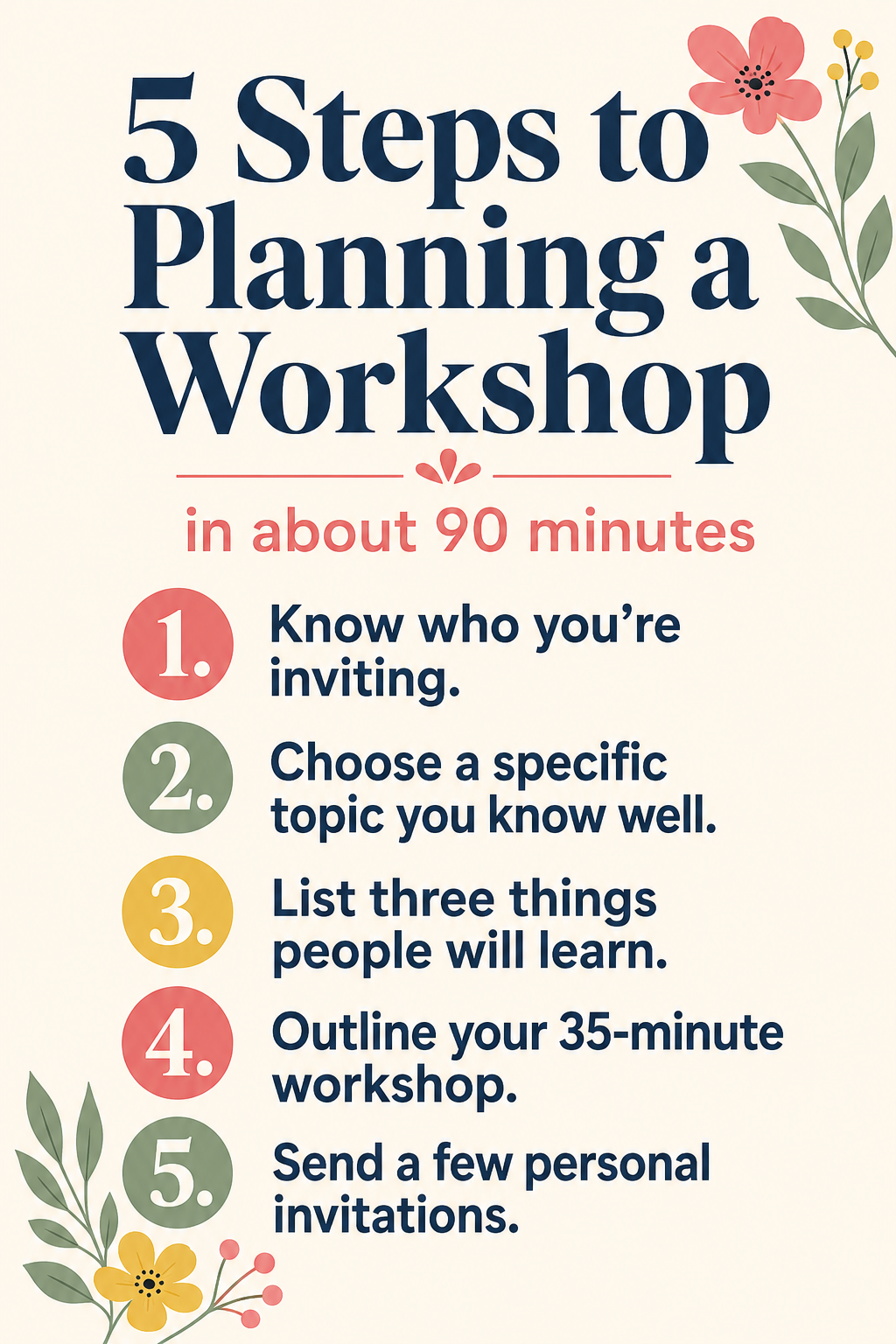
Here’s a five-part plan:
- Get clear on who you’re inviting. Potential customers in your niche, other designers, local business owners, and quilters will all arrive with different interests and questions. Choose your audience first so you can shape the topic around them and promote it where they’re likely to see it.
- Pick something specific and familiar. Choose one repeat technique, one file setup, or one way to improve a product listing. Aim for a process you know well enough to explain comfortably. “Surface pattern design” is a whole subject; your workshop needs a small piece of it.
- Name three things people will learn. Start with, “By the end of this workshop, you’ll be able to…” Your three takeaways should fit into one or two straightforward sentences. If explaining the outcome takes a paragraph, narrow the topic a little more.
- Give your 35 minutes a simple structure. Allow three minutes to welcome everyone and make introductions, 22 minutes to teach and demonstrate, seven minutes for questions, and three minutes to wrap up.
- Make a few personal invitations. Promote the workshop through your newsletter and social accounts, then think of a few people who would find it helpful and invite them directly. Letting someone know you thought of them can begin the connection before they even attend.
A registration form is useful for collecting names and email addresses so you can send the workshop link and a reminder. Be clear about what happens after that, too. If registration also includes your regular newsletter, tell people before they sign up.
Some attendees may enjoy learning from you and later decide your newsletter isn’t relevant to them. That’s okay. Unsubscribing doesn’t erase the time you spent together or the value they took from it.
Focus on bringing together people you can help, giving them a useful experience, and making it easy to stay in touch.
And before you spend an afternoon choosing slide fonts, choose a date. Putting the workshop on your calendar gives you something concrete to work toward—and a reason to finish preparing it.
Your Free Workshop Setup: What You Actually Need
You don't need expensive webinar software for your first workshop. Here's a setup you can put together without spending a dime.
Use a free video call plan for a 35-minute session. Most free plans cap group meetings around 40 minutes, which is why planning for 35 gives you breathing room on either end. (Double-check current time and participant limits before you build your registration page, since these things shift.)
Create a simple registration page through your email platform. Include the title, who it's for, your three takeaways, and the date and time. Look at your platform's free plan details before you commit, since limits on forms, landing pages, and subscriber counts vary and change. Personally, I use Kit. It's got a solid free tier and it's learning curve is pretty beginner friendly.
Send the link and reminder manually. Automated sequences usually require a paid plan. For a first workshop, a manual confirmation and a manual reminder are more than enough.
Share your screen for a live demonstration. If you're teaching from an iPad, most video platforms let you mirror your device through the desktop sharing menu. Wireless screen mirroring works, or a cable connection for something more dependable.
Only record what you have permission to share. Tell everyone up front if you're recording. If you want to offer a replay, record the teaching portion but pause before introductions or live questions. That gives you something useful without turning a friendly conversation into permanent public content.
Your first workshop doesn't need to be a polished webinar. It needs to be a place where people learn something useful, talk to one another, and walk away feeling like they know you a little better than they did an hour ago.
That's how professional relationships grow roots.
Where to Start This Week
If the idea of teaching a workshop has been sitting in the back of your mind for a while, this is your nudge to pick a date.
Once it's on the calendar, the rest tends to follow. And if you want a foundational framework for thinking through the business side of decisions like this one, my free workbook, Master the ABCs of Your Art Biz, walks through exactly this kind of business thinking.
If you're further along and want a more structured look at where your business systems could use some attention, my Art Biz Audit digs into that with you directly.
And if you want more of this kind of thinking delivered to your inbox every week, that's exactly what my 3, 2, 1… Let's Design! Eduletter is for.