How to Price a Licensing Deal (Without Guessing, Panicking, or Underselling Yourself)
Sep 15, 2026What would you do if a brand emailed you out of nowhere and said, We love your style.... What would you charge for this pattern?
Your stomach would do that little flip. Maybe adrenaline, excitement, and panic would all show up at once.
The magnetic pull to fire off an answer right away would be very strong. You'd want to look responsive. I mean, you don't want to look like you don't want the work.
Resist that urge.
Don't answer without a system in place to make sure you're pricing your time and talent according to the current market and the actual job they're asking you to do.
Because "what would you charge for one pattern" is not actually the question. The real question is: what is this costing you in time, talent, and resources?
Why You Can't Price a Pattern in Isolation
Here's where people get stuck. They think they're pricing a pattern. A pretty little floral, a fun geometric, whatever it is.
You're not pricing the pattern.
You're pricing the entire scope of what they're asking you to hand over. Exclusivity, territory, term length, how they're allowed to use it. All of that changes the number, sometimes a lot.
I learned this the hard way. Years ago I was designing merch for a band, a big festival gig. I delivered the final artwork. Everything seemed fine.
Then I saw the t-shirts.

Someone had "tweaked" the colors. And by tweaked, I mean they changed the entire color scheme and made it glow-in-the-dark. My name was still attached to that design, but it had become something I never would have sent out under my own name.
I hadn't asked. I didn't have a written policy about it. Lesson learned the hard way.
What Questions Should You Ask Before Quoting a Licensing Deal?
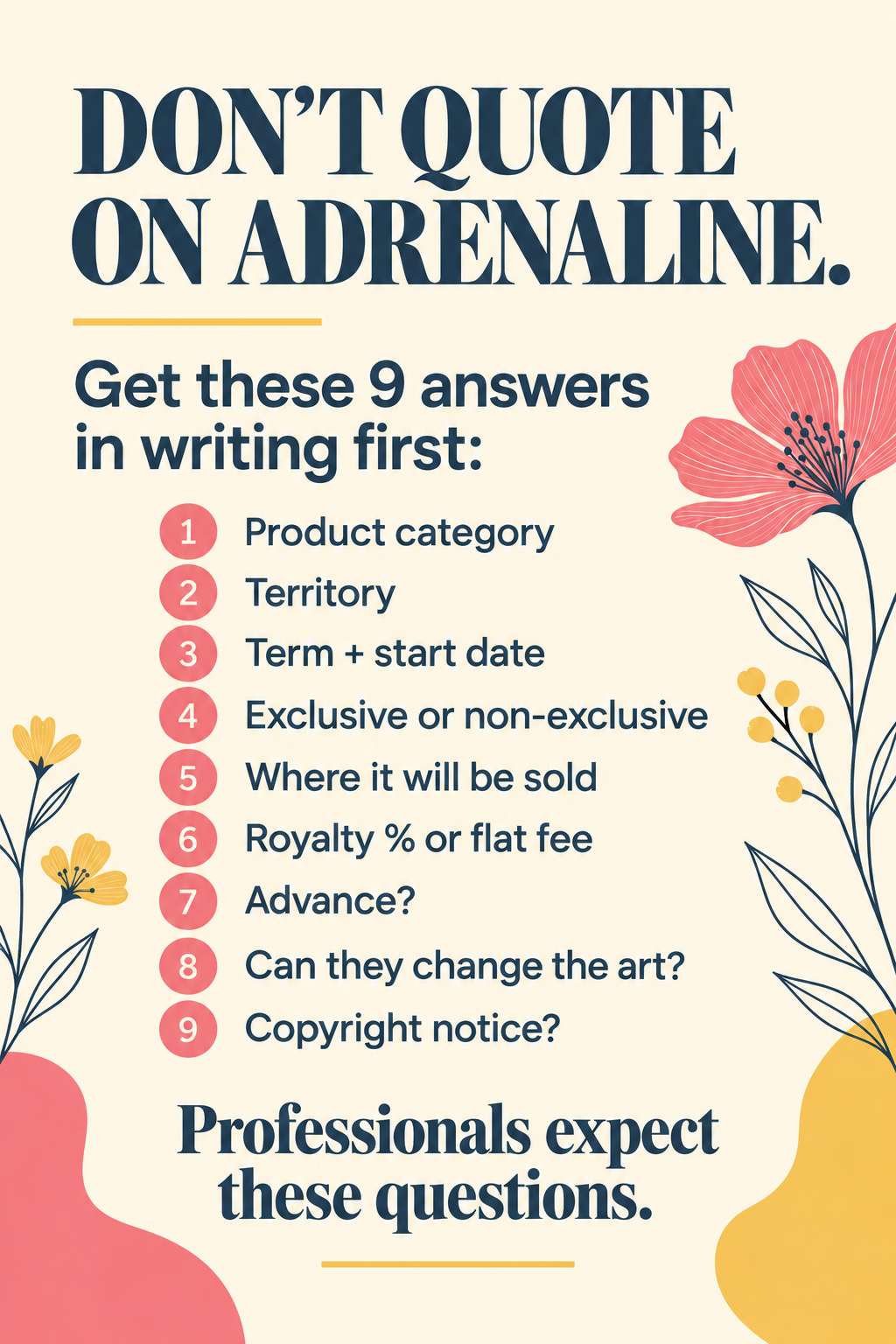
Here are the nine questions you need to have answered in writing before any quote goes out:
- What is the product category?
- What territory will it be sold in? (US only, worldwide)
- Term length, and the date the term starts. ("Two years" means nothing without a start date.)
- Is this exclusive or non-exclusive, and scoped how? (Exclusivity can be limited by category, territory, time, etc.)
- Where will the products actually be sold?
- Is payment a percentage royalty or a flat fee?
- Is there an advance?
- Can they change your art without your approval?
- Will your copyright notice appear on the product?
Having those answers in writing before you start a project saves you from the uncomfortable conversations and creative frustration that come from finding out later, the way I did with those glow-in-the-dark t-shirts.
Quote the Scope, Not Just the Pattern
Professionals do not expect a firm quote in your first reply.
A short, professional 'holding' reply is completely normal. Something like:
Thanks for thinking of me! A few quick questions so I can quote accurately: (then your nine-question list).
Sending an email like this helps you in two ways. 1. It shows you're responsive and professional. 2. It buys you the time to review the request so you're not pricing on adrenaline.
When you do respond with a quote, remember: you're not pricing the pattern by itself. You're pricing the entire job they're asking of you.
Exclusivity Gets Its Own Line
If a brand wants the only version of that design in their category, they're asking you to give up every other deal in that category for the length of the term. That's a real cost to you, and it deserves its own line item in your quote. Make sure you point that out to the client directly, so they understand.
What's a Typical Royalty Rate for Surface Pattern Licensing?
For a starting point, general industry guidance from surface pattern licensing resources tends to land somewhere around: apparel fabric around 5–8% of net sales, quilting and fabric collections 5–10%, home decor 5–12%, and stationery and gift 5–8%.
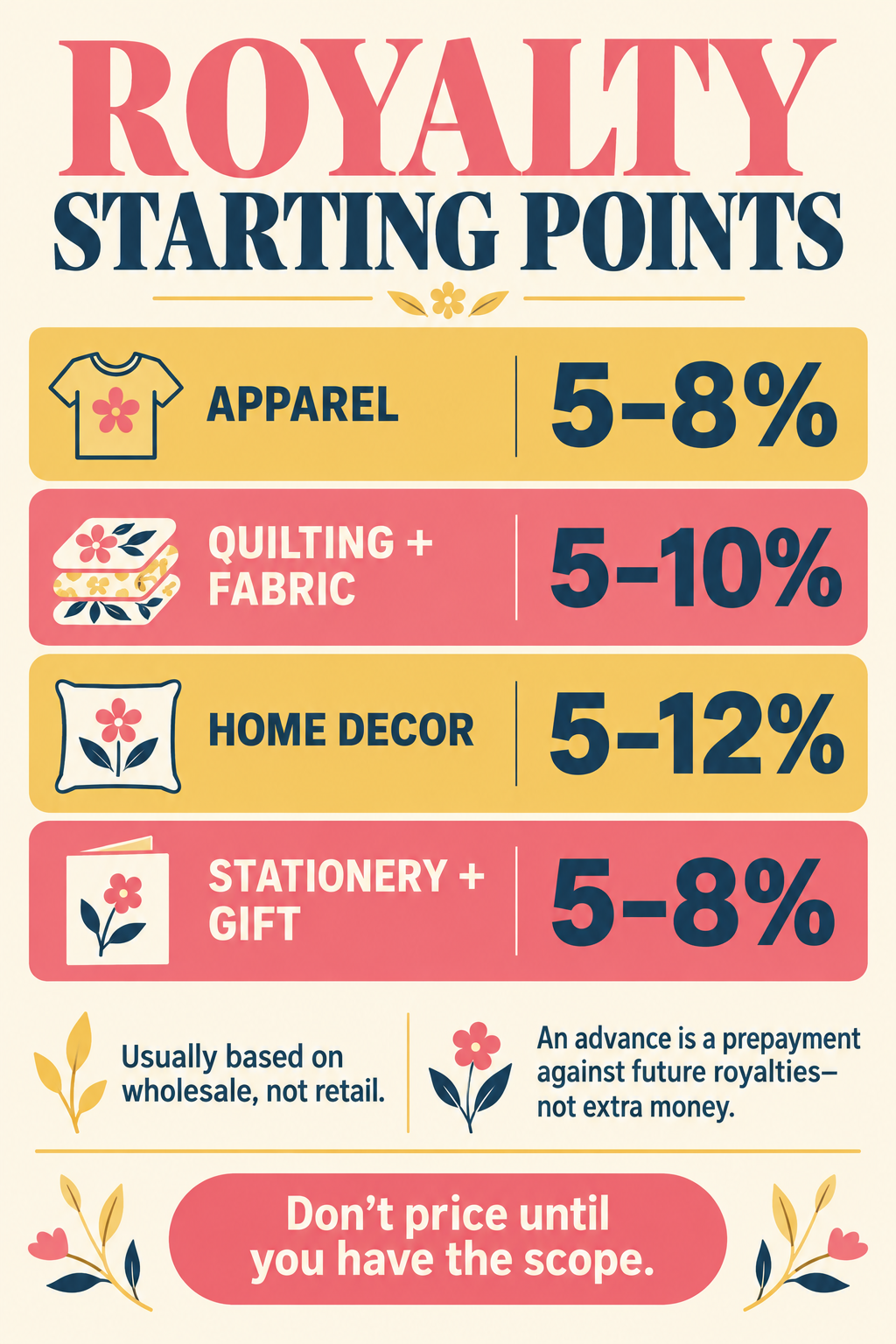
One more thing people miss: royalties are usually calculated on wholesale price, not retail. So if a product wholesales for $10 but retails for $20, your royalty percentage is calculated on the $10.
Always do your own research on current rates before you quote, but at least now you have a place to start.
A note about advances. A lot of designers think an advance is extra money on top of their royalty agreement. It's not. An advance is a prepayment. It comes out of your future royalties until you earn it back.
Before you send any quote, make sure you've included the number of revisions included at that price, and a specific expiration date for the quote itself. Don't leave it open-ended.
What To Do With This Today
You don't need to build the whole system this afternoon. Save this email for when the next inquiry lands (because it will), and do one thing right now: put the nine questions where you'll actually see them.
If pricing has been the thing keeping you from replying to opportunities, I can help you with an Art Biz Audit call. Bring your offers, and we'll go through it together.
Either way, the goal is the same: stop pricing on adrenaline, and start pricing on information.