How to Get Found on Spoonflower: 3 Ways to Help Shoppers Discover Your Designs
Sep 25, 2026By Mandy Corcoran — surface pattern designer and former tech instructor. I build the tools I teach, including PatternPAL Pro.
You upload a design you love, make it available for sale, and then wait for shoppers to find it. And wait. And maybe refresh your shop page once or twice, just in case.
With over 1.5 million designs (and counting), Spoonflower is a crowded marketplace. But that also means buyers are there. A lot of them and they're searching for your designs for their sewing and home decor projects. Your job is to make it easier for the right shopper to find your design and explore the rest of your work.
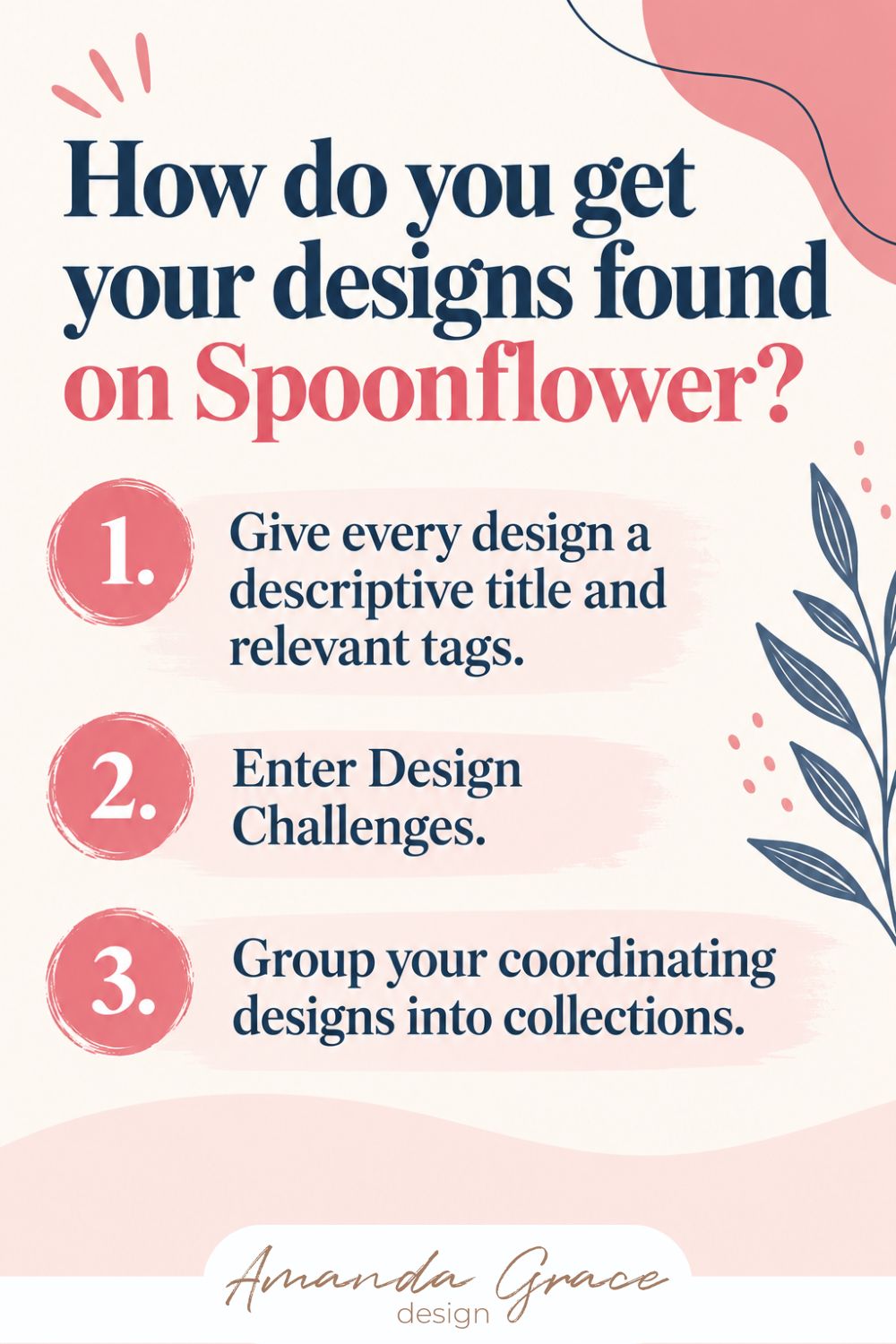
How do you get your designs found on Spoonflower? Before you tear the whole shop down and start over (I know the urge), try three things first.
1. Give every design a descriptive title and relevant tags.
2. Enter Design Challenges.
3. Group your coordinating designs into collections.
Will this guarantee you page one or a sale tomorrow? Not necessarily. What it does is give shoppers more doors into your work.
How should you title and tag Spoonflower designs?
It's not as hard as you might think. The best way is to use the words a shopper would. Try to to describe what they see when they're looking at your pattern. Spoonflower says a design title should be unique, descriptive, direct, and no longer than 75 characters. It also allows up to 13 tags per design. Think subject, style, prominent colors, and defining details—not a poetic name. Think practical and literal.
Imagine someone needs fabric with lstrawberries and strawberry flowers for a kitchen project. They aren't searching for Summer Memories at Grandma's House. Don't get me wrong. I'm a sucker for summer memories at grandma's house. But I'm not going to search that on Spoonflower.
I use a simple formula:
Primary subject + secondary element or style + color, if useful
For example:
Less Searchable ➔ More Descriptive
Summer Memories ➔ Strawberries and Flowers in Pink and White
Into the Woods ➔ Woodland Foxes and Mushrooms in Rust and Sage
Keep the wording natural.
A title isn't a place to list every possible synonym. For tags, add useful details that didn't fit in the title, such as hand drawn, small scale, or a predominant color, when they accurately describe the design. Spoonflower advises against repeating the same word across tags and says its search ignores product-name tags such as fabric and wallpaper.
Here's my quick test: If a buyer read the title without seeing the image, would they have a reasonably accurate picture of the print? If not, get more literal.
You can tell the story behind the artwork in the description. That's a good place for inspiration, possible uses, and details a customer should know. The title and tags should lead with visible features. These recommendations follow Spoonflower's guidance on preparing designs to sell.
I use Claude to speed up this part, then check every suggestion against the actual design. Here's how I use Claude to write Spoonflower titles faster (prompt included).
Spoonflower Design Challenges help people discover your work
A Spoonflower Design Challenge puts your entry in a themed gallery where people browse and vote. Voters can also favorite entries for later. Someone may discover a design they love even if it doesn't win.
If your entry finishes in the top 100, Spoonflower says it receives an Award Winner badge, and shoppers can filter search results for award winners. Top finishers may also be featured elsewhere on the site or in Spoonflower's marketing. Those are opportunities that can turn into traffic and sales.
Choose themes that fit the work you'd want to make anyway. Read the brief, enter a design, and take the time to see what other artists are submitting. Voting for your favorites, even in challenges you're not in, is worthwhile community participation.

3. How do collections help shoppers find your designs?
Say a Spoonflower customer looking for home decor finds your beautiful floral print and loves it. Now she needs some other patterns to go with it - to pull the room together. She's looking for a secondary coordinate and a subtle blender in the same palette.
A collection gives her a clear next step. Group designs by a shared theme, palette, or project so a buyer can move from one print to its coordinates. Spoonflower's search offers a Collections option, and shoppers can browse public collections from an artist's shop. On a design page, a shopper may also see a View Collection link for a design you've placed in a collection. See Spoonflower's guides to searching the site and finding coordinating designs.
Keep each group coherent. A focal print, a smaller companion, a stripe, and a blender offer useful choices for a quilt or a room. Think about what someone might want alongside the print that first caught her eye.
One practical detail: Spoonflower currently requires at least five designs before an artist can make a collection public. Check that the collections you want shoppers to see are actually set to public. Spoonflower's collection guide shows how.
What should you update first in your Spoonflower shop?
Pick five designs you want shoppers to find. Rewrite any vague titles, check that each tag describes a real feature, and if those 5 designs coordinate, put them in a collection. Then look at the current Design Challenge themes and see if there is one that fits you.
You don't have to fix your entire shop in an afternoon. Give shoppers a clearer path into one good corner of it, and build from there.

Use my free Claude prompt to create your own Spoonflower naming assistant. And if you want to build this kind of workflow in your own Claude (your designs, your voice, your shop) start where I start everyone: the first two sessions of Creative Systems Lab (FREE).
Session 1 walks you through personalizing Claude so it knows your business. Session 2 gives you a prompting formula and a saved prompt library, which is exactly what makes a prompt like the one above work specifically on your shop.
Both sessions are free. One signup, and the replays and materials are yours to keep.
Quick answers about Spoonflower discovery
What words should I use in a Spoonflower title?
Name the main subject first, then add a distinguishing element, style, or color. Keep it readable and under Spoonflower's 75-character limit. Strawberries and Flowers in Pink and White tells a shopper more than Summer Memories.
Should I repeat keywords in Spoonflower tags?
No. Spoonflower says repeating words across a title and multiple tags doesn't help its search. Use the available tags for distinct, accurate details such as motif, style, and predominant colors.
Do you have to win a Design Challenge to benefit from entering?
No. Your entry can be browsed, favorited, and discovered during voting. A top-100 finish adds an Award Winner badge and eligibility for an award-winner search filter, but discovery isn't limited to winners.
How many designs do I need for a public Spoonflower collection?
At least five, according to Spoonflower's current artist guidance. Once you have five coordinating designs, make sure the collection's public setting is turned on.