
Drop Shipping vs. Print on Demand: What Every Surface Pattern Designer Needs to Know (Before Making a Single Product)
Feb 26, 2026Okay, let's address the elephant in the Etsy shop.
I get this question so often that I should probably just tattoo the answer on my forehead: "Mandy, what's the difference between drop shipping and print on demand? Aren't they the same thing?"
The thing is, it’s complicated. And if you just Google the question, you’re not always going to get the right answer.
So let's clear the creative air once and for all. Because if you're a surface pattern designer thinking about getting your art onto actual, physical products — and you should be — understanding this distinction isn't just helpful. It's the difference between building someone else's brand and building yours.
Grab your coffee. We're sorting this out today.
The Simplest Explanation You'll Ever Get
Here's how I explain it when I'm on my third espresso and feeling generous with metaphors:
Print on Demand marketplaces (think Redbubble, Society6, Spoonflower) are like renting a booth at someone else's craft fair. You bring your art, they provide the booth, the customers, and the credit card reader. The buyer knows they bought from that craft fair. Your name? It's on the tag, sure. But it's not the headliner.
Drop shipping (using fulfillment companies like Printful or Printify) is like having your OWN craft fair booth — with your own banner, your own vibe, your own curated display. When someone buys that gorgeous butterfly tote bag, a behind-the-scenes team prints and ships it for you. But the customer? They feel like they bought from you. Because they did.
Both models print products after someone orders. Neither requires you to turn your garage into a warehouse (thank goodness — mine already has enough "I'll organize this later" energy). But one builds their brand, and the other builds yours.
And honestly? Neither one is something you have to do. But knowing the difference matters more than you might think. Because the path you choose changes everything — from how much time you invest to how much control you have.
Let's break each one down.
Drop Shipping: The Business Model That Sounds Sexier Than It Is (At First)
As a surface pattern designer, you absolutely CAN drop ship products featuring your designs. Some very successful designers have built entire businesses this way. And when it works? It really works.
Here's what it looks like in real life: You take one of your pattern designs — let's say that butterfly collection you've been perfecting — and list it on a tote bag in YOUR online shop. Shopify, Etsy, your own website, wherever. A customer finds it, falls in love, and clicks "buy."
Behind the scenes, a fulfillment company like Printful or Printify prints your design onto that tote bag and ships it straight to your customer. Your branding. Your packaging. Your customer relationship. They never know a third party was involved.

The upside? You get to build YOUR brand. Your shop, your aesthetic, your customer list. You control the pricing, the product descriptions, the whole shopping experience. And because you're not paying for products until someone actually orders? No warehouse full of tote bags gathering dust next to that yoga mat you used twice.
Some designers have built really beautiful, recognizable brands this way — curated shops full of products featuring their art, and they never touch a single item.
So Why Isn't Everyone Doing This?
Because it's more work than uploading to Spoonflower and calling it a day.
With drop shipping, you're responsible for setting up and maintaining your own online store. You're writing product listings, creating (or mocking up) product photos, driving traffic through marketing, handling customer service and returns, and managing your cash flow — because you collect payment first, then pay the fulfillment company for production and shipping.
That last part is important. Your profit is the difference between what you charge and what the fulfillment company charges you. And since items are printed one at a time (not in bulk), your per-unit cost is higher than traditional manufacturing. So your margins can be tighter than you'd expect.
"But Mandy, I see designers with their own shops and it looks amazing!"
It IS amazing. And those designers have usually invested real time into building an audience, dialing in their niche, and learning the marketing side of things. It didn't happen overnight. It happened after a lot of late nights, testing, and figuring out what their specific audience actually wanted to buy.
The bottom line: Drop shipping with your own store is a powerful way to build a brand around your art. But it's not the most passive option out there. If you're still figuring out your niche or testing what resonates, jumping straight into managing your own storefront might be putting the pattern before the repeat tile.
File drop shipping under "exciting next step" and keep reading.
Print on Demand Marketplaces: Your Designs, Without the Headache of Inventory
Now let's talk about the path that's easiest to start with — and honestly, the one I recommend for most pattern designers who are just getting their feet wet.
POD marketplaces like Redbubble, Society6, and Spoonflower are basically giant online stores that let you upload your designs and put them on products. Throw pillows. Phone cases. Wallpaper. Fabric. You name it, there's probably a POD site that prints it.
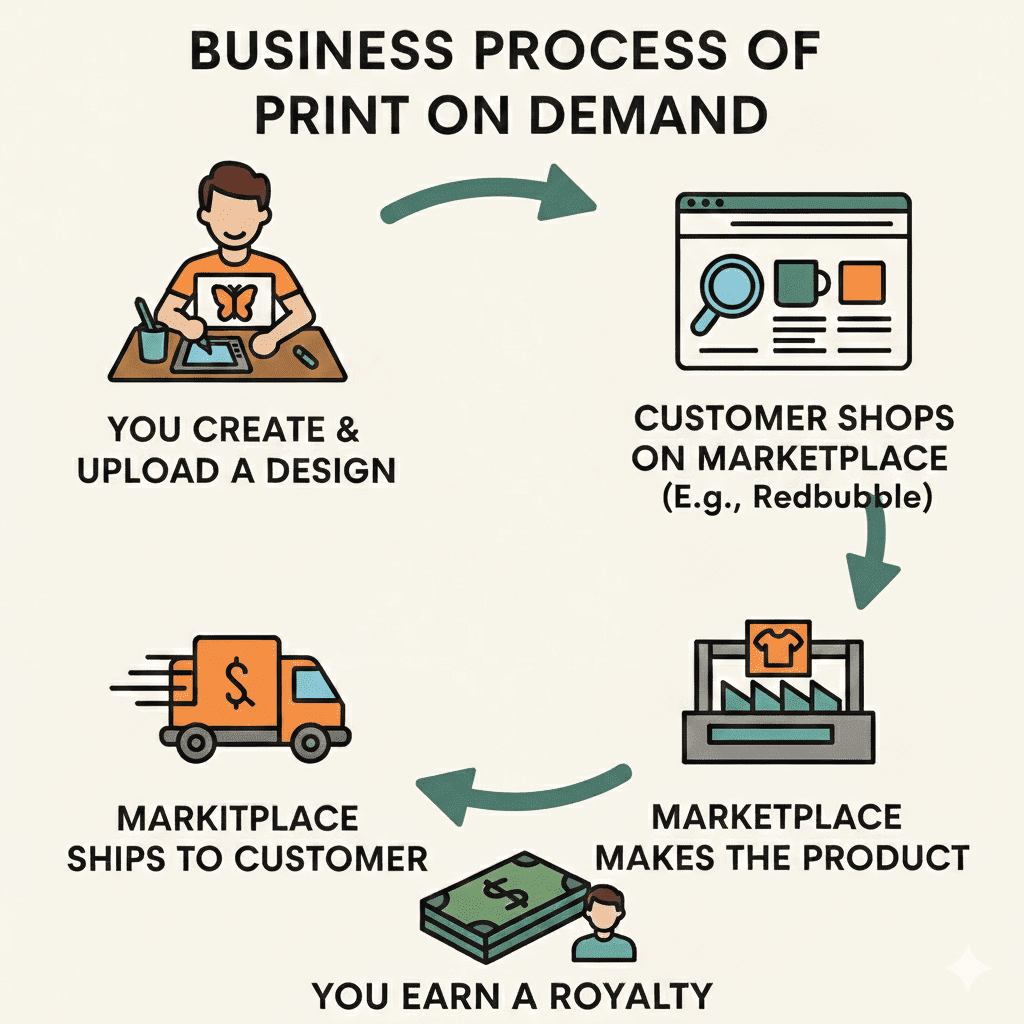
You upload your art. Someone browsing their website falls in love with your butterfly throw pillow. They buy it. The company prints your design onto that product right then and ships it directly to the buyer.
You never touch a thing.
The storefront? Theirs. Payment processing? Theirs. Printing, shipping, customer service? All theirs. You get a royalty or commission on each sale. Upload, wait, get paid. It's about as hands-off as it gets — which is pretty great when you're short on time. Or when you'd rather spend your hours actually designing instead of answering emails about shipping timelines.
The Tradeoff
You're building inside their house. The customer relationship belongs to them. Your brand doesn't really grow in the traditional sense. And your margins are whatever they decide to give you.
But as a way to get your art out into the world with basically zero risk? It's really hard to beat.
And here's what a lot of people don't talk about: POD marketplaces are an incredible testing ground. When I started putting my collections on POD platforms, they became my real-time market research. I could see what themes sold, which colorways customers gravitated toward, and which designs got crickets. That data became invaluable later when I approached licensing companies — because I already had proof of what people actually wanted to buy.
If you're going the POD route, make sure your files are prepped properly. Each platform has specific requirements for resolution, file format, and color profiles. Getting this right from the start saves you the headache of re-uploading everything later. (And trust me, there's nothing quite like discovering your gorgeous floral looks like a muddy mess because you forgot to check the color profile. Ask me how I know.)
If you want a structured system for creating collections that are ready for POD platforms — from composition to color palettes to file prep — my Procreate Pattern Collection Masterclass walks you through the entire process. It's designed for exactly this: getting your patterns from your iPad to actual products, looking polished and professional.
So... Which One Should You Choose?
Here's where I give you the permission slip you didn't know you needed: you don't have to do both. You don't even have to do either one right now.
It comes down to your business model, your bandwidth, and where you are in your creative journey. Here's my honest take:
Start with POD marketplaces if you're: still finding your style, new to selling products, testing which designs resonate, or short on time and want a low-maintenance way to get your art onto products.
Consider drop shipping when you're: ready to build a recognizable brand, comfortable with marketing and driving your own traffic, willing to invest time in storefront management, and wanting more control over pricing and customer experience.
Focus on licensing if you're: creating cohesive collections rather than one-offs, more interested in partnering with established brands, and not interested in managing products or storefronts at all.
Some designers thrive with shops on multiple marketplaces. Others focus entirely on licensing and skip products altogether. And some absolute overachievers do all three. (They also probably don't sleep, but that's their journey.)
The only wrong move is thinking you have to do it all at once. That's the fastest route to burnout, and nobody's creating their best patterns while running on fumes and resentment.
The Part Nobody Tells You: Your Patterns Need to Be Collection-Ready
Here's the thing that ties all of this together, whether you choose POD, drop shipping, licensing, or some combination: your patterns need to work as collections, not islands.
A single gorgeous pattern on a tote bag is nice. A cohesive collection across multiple products? That's what makes a customer buy the tote AND the throw pillow AND the phone case. That's what catches a brand's eye when they're browsing for licensable art.

If you've been designing one-off patterns and wondering why they're not gaining traction, this might be the missing piece. Collections tell a story. They solve a problem for buyers and brands who need coordinated designs across products.
Want to learn how to think in collections instead of single patterns? My Procreate Pattern Collection Masterclass covers everything from building mini-collections with hero patterns, supporting patterns, and blenders to prepping your files for POD platforms and licensing.
And if Photoshop is more your speed, Photoshop Patterns Unleashed dives deep into creating seamless repeats with layers, clipping masks, and smart objects — plus you get the PatternmagicPRO action set to seriously speed up your workflow.
Let's Recap Before You Go
Drop shipping = You sell on YOUR platform, a fulfillment company prints and ships. More control, more work, more brand-building potential.
Print on Demand = You upload to THEIR platform, they handle everything. Less control, less work, great for testing and passive income.
Both can work for surface pattern designers. Neither is "better." The best choice is the one that matches where you are right now — not where Instagram makes you think you should be.
And no matter which path you choose, the foundation is the same: create cohesive, professional collections that make people stop scrolling and start buying.
If you want weekly tips on building your pattern design business (without the overwhelm), my free 3, 2, 1... Let's Design Eduletter lands in your inbox every Thursday with design tips, business encouragement, and the occasional terrible pun. You know you want in.
Now go make something beautiful — and know exactly where you're putting it.